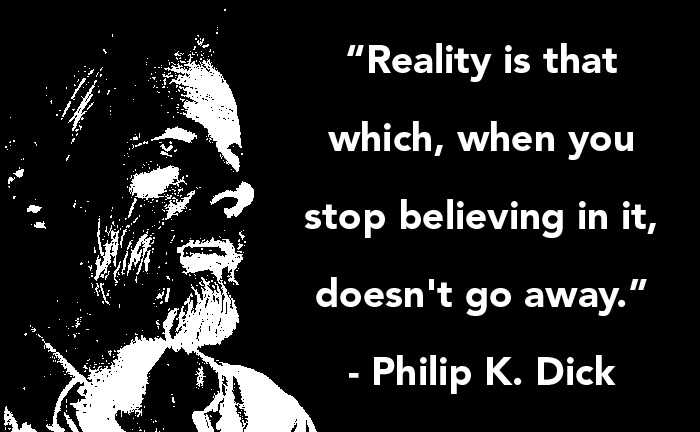
Reality is that which, when you stop believing in it, doesn’t go away

One of the most profound statements I know is by Science Fiction writer, Philip K Dick, best known for Bladerunner. In his 1978 essay ‘How to Build a Universe That Doesn’t Fall  Apart Two Days Later’ Dick said “One day a girl college student in Canada asked me to define reality for her, for a paper she was writing for her philosophy class. She wanted a one-sentence answer. I thought about it and finally said, “Reality is that which, when you stop believing in it, doesn’t go away.

What is of most interest to me is its converse – An unreality is that which, when you stop believing in it, goes away. Several major topics come to mind which I will discuss later.

I have always been interested in research and invention. I completed degrees – Bachelors, Masters and PhD in Chemical Engineering. But at the end of my PhD I realised that scientific research for its own sake did not seem possible to me at that time. Modern scientific research is no longer the realm, as it was up to the 19th century, of gentleman scientists with independent means studying topics of interest to them. Most R&D is funded by private businesses or government research programmes and these funders want results that will benefit their financial or policy interests. The researcher is no longer independent. Junior professors at research universities spend most of their time writing grant proposals to try and interest these funders.

I preferred to work in industry, where at least the motivation was to improve production process to make a profit. Now as I get older and more financially secure, I find myself drawn to topics that interest me. And what interests me most are topics where establishment interests are promoting scientific hypotheses that don’t ring true.

The first topic to attract my interest in early 2000s was global warming. At first, I had no reason to disbelieve the catastrophe narrative. But my scientific interest, and knowledge of the core subjects of chemical engineering, heat and mass transfer, encouraged me to investigate the science behind the catastrophe theory. I soon found that doubling the concentration of carbon dioxide in the atmosphere would cause no more than 1°C of warming based on heat and mass transfer principles. This small temperature increase was generally agreed to be beneficial rather than harmful. I immediately started to tell everyone not to worry. But I got strange reactions, like that of a former engineering class colleague who questioned my religion! Wasn’t this a scientific topic?

In 2007 the UK Channel 4 TV documentary ‘The Great Global Warming Swindle’ debunked the global warming hypothesis and the Gore film from the previous year. After that, the ruling oligarchs through their control of governments and mainstream media made sure that from then on ‘The Science’ was never again allowed to be questioned in mainstream media. I watched on in disbelief as governments ruined their countries’ economies by implementing costly green energy policies based on a big lie. Sceptics were systematically ignored. Only the oligarchs’ current desire for cheap energy to power AI is likely to end these costly policies.

And in March 2020, COVID19 struck. At first my disbelief was that governments all over the worlds enacted excessive lockdown policies for a cold virus with cruel police state enthusiasm. This hadn’t happened for more serious influenza epidemics in 1950s and 60s. But as the scamdemic continued into 2021, I researched deeper and deeper. Reading the revised edition of ‘Virus Mania’ by Engelbrecht et al was my ‘red pill’. Not only was COVID19 unreal, but also all other viral illnesses. AIDS is not sexually transmitted. Polio probably caused by poison, etc, etc.

This new understanding of the frailties of germ theory made me question other illnesses. In 2022 I travelled to sub-Saharan Africa and my travelling companion asked me to get malaria tablets. I investigated the various options and found the efficacy of all questionable. I did not get the tablets and did not contract malaria.

This sent me on my new research quest. I found that very little had been written questioning the mosquito plasmodium transmission story. If you think about this logically, it seems very unlikely that a mosquito feeding on blood could transmit the sufficient number of plasmodia back to its salivary glands and into a new victim to transmit disease.

So, I researched and wrote the book ‘Malaria is spread by mosquitos?’. This included translating from Italian into English for the first time Battista Grassi’s 1901 ‘studi di uno zoologo sulla malaria’ (Studies of a Zoologist about malaria). Why hadn’t this work, so often cited as proof that malaria is spread by mosquitos, been translated before? It is far from convincing as Grassi clearly suffered from confirmation bias in his research on this topic.

Each week I write a blog article on malaria research in the blog at usmalaria dot com website and in the Understanding Malaria LinkedIn group. And I peruse whatever else comes up in my LinkedIn feed. And most people seem to believe in catastrophic climate change and the Vs of germ theory, viruses and vaccines. I posted a response to a post boasting about a teenage boy getting the HPV vaccine which is supposed to prevent cervical cancer. Boys don’t have a cervix. The discussion continued for a while and based on the responses and the likes they received from others it was clear that no evidence I presented was going to the minds of these people.

Many people have strong religious beliefs, and curiously, unquestioning faith in the religion’s dogma is praised by many. I recently came across a video that told me that there is scant evidence that the central figure of my religion even existed. But I know better than to get into a discussion with a religious person on this topic.

But the same kind of faith seems to apply to many supposedly scientific theories. The mantra ‘Believe the science’ highlights this. The scientific method is supposed to be sceptical. Whether it is germ theory or global warming, many want to believe. And they use language typically used for religious heretics to attack sceptics.

To come back to Mr Dick’s profound words, it seems strange to me that so many people accept realities that objective examination would cause to go away. I now realise that I have to accept the reality that the majority of people want to believe easily falsifiable untrue hypotheses about science, politics and religion. The majority wants to support evil policies and regimes if told they are good by the ruling classes. If I chose to believe that all people are openminded and not afraid of examining their beliefs, that would not change this reality. We red pillers will always be a small minority and unfortunately we need to accept this reality.

There is always a better way

On May 1, 2020 I posted a blog post with the same name launching my book of the same name about identifying better ways of manufacturing. ‘There is always a better way’ is much more to me. It is my mission statement, what makes me tick. When I am doing most tasks I always ask myself is there a better way of doing it? The answer is nearly always yes, but often the benefit of implementation is not worth the cost of time that could be spent on other tasks.

Underlying my philosophy is my belief in the utilitarian principles of Jeremy Benthem further described by John Stuart Mill, to strive to act in a way that does the most good for humanity. This philosophy has been strengthened for me in recent years when I discovered Jose Silva’s self-development method. The ‘prayer’ at the end of the exercises says it so well

Every time you function at these levels of the mind you will receive beneficial effects physically and mentally. You may use these levels of the mind to help yourself physically and mentally. You may use these levels of the mind to help your loved ones physically and mentally. You may use these levels of the mind to help any human being who needs help physically and mentally. You will never use these levels of the mind to harm any human being. If this be your intention, you will not be able to function within these levels of the mind. You will always use these levels of the mind in a constructive, creative manner for all that is good, honest, pure, clean and positive, and this is so. You will continue to strive to take part in constructive and creative activities to make this a better world to live in. So that when we move on, we will leave the world behind a better place for those who follow. You will consider the whole of humanity depending on their ages as fathers or mothers, brothers or sisters, sons or daughters. You are a superior human being. You have greater understanding, compassion and patience with others.

In the real world in many cases reality can make it difficult to live this philosophy. We have to earn a living to support ourselves and our loved ones and in many cases the goals of those for whom we work are not fully in alignment with this ideal. In the past I was involved in decisions about how we would sell or market a product. The decision was usually what we could do that would maximise revenue for the company, and not what would be of maximum benefit to humanity. Both objectives are important. The company needs to make money to prosper and pay its employees and investors. However, in the long term, unless the goals are in alignment with improving the lot of humanity, the benefit is only short-term.

I will always strive to find the best way to complete assigned work tasks, within the constraints of my clients. And I do not choose clients who do not align with this principle.

I have now reached the stage of life when I have more time available and greater financial security to allow me to work on constructive tasks that can make the world a better place in which to live. Events of the last two decades, and in particular, the last four years have made this seem much more important. It seems clear that this utilitarian philosophy is not shared by those in control of most institutions, government, academia and business.

The promotion of policies that harm many people to solve problems that are not real has become a major issue. These policies are exactly opposite in effect to Utilitarianism. They act in ways that harms humanity. They benefit narrow, but powerful interests, while harming the overall majority. The two most egregious examples are the supposed climate catastrophe and the supposed COVID-19 pandemic, but they are only two examples.

In my own small way, I find better ways to promote the flourishing of humanity. I spend my spare time researching and writing about topics that can benefit humanity, especially by challenging dubious dogmas, that benefit narrow interest groups at the expense of the majority of humanity. To this end I recently completed the book ‘Malaria is spread by mosquitos?’. For this project I translated ‘Studi di uno zoologo sulla malaria’ by Dr G Battista Grassi from Italian to English for the first time since it was published in 1901 (‘Studies of a zoologist about malaria’). Isn’t it interesting that this 140,000 word book that underlies the accepted mosquito-plasmodium malaria transmission story (tall tale?) was not translated before?

If aid agencies strove to provide better food and water, I expect it would do more to eliminate malaria than poisoning the environment to kill pollinating insects and poisoning undernourished children with dubious drugs and vaccines, and insecticide impregnated nets. There is no doubt more research is needed on the causes and cures. Links to both books are available on the website usmalaria.com.

Ask yourself what you can do to benefit humanity? Any benefit to your family or community that does not harm others has a net utility score. If more of us act to benefit humanity, this will become a better world  us and our children.

The Future is African

Hippopotamus in Okavanga Delta, Botswana

I visited Africa for the first time this winter. It was great to leave dreary wet Northern Europe to enjoy the sun vertically overhead near the Tropic of Capricorn in December. What was also pleasant was the optimism of the people and the feeling that Africa is developing quickly and the living standards of the people could soon catch up with the west.

Nearly everyone has a smart phone and the 4G coverage is good. One of the first things I did was get a local SIM to avoid roaming charges. The cars were the same as in West – mostly Japanese and typical western brands. The roads around the capital city of Botswana, Gabarone, are mostly well built. There are many new flyovers recently built by Chinese construction companies.

I was struck by a feeling that Africa has a future. I see similarities with the Ireland of 1970s in which I grew up. There are many small children. The continent is vast with much space to accommodate a rising population. There is much mineral wealth. There is a great climate for growing food and cash crops.

There are three major issues to be tackled to allow Africa to flourish – Energy, Water and governance.

While it needs much improvement, of the three we should be less worried about governance. Historically, much of Africa was ruled by colonial masters whose modus operandi was to divide and conquer the local peoples. This legacy continues with the borders of nation states typically the same as the colonial boundaries. Countries with less tribal division like Botswana do not suffer from the same issues. As the people’s expectations increase their tolerance of poor governance will decline and they will find ways to live peacefully and productively.

Availability of clean water is a major issue. Africa is the second driest continent with 9% of worlds fresh water for 16% of world population. Despite this relative lack of water, with good management there is sufficient water for drinking, agriculture and industrial needs.

Water is not evenly distributed geographically and rainfall is typically seasonal. Water distribution infrastructure is not well developed in many places.

For future economic developments in industry and agriculture more water is needed. To meet this need more infrastructure is required. More reservoirs, pipelines and associated purification facilities are needed. Many projects will cross borders.

These projects are feasible. With organisation and support there is no reason why water scarcity will continue to be an issue except in the most arid and sparsely populated areas.

Energy is not as available or reliable as elsewhere in the world. There is a deficiency of electricity infrastructure and a shortage of bottled hydrocarbon fuels for cooking, etc. In many places people have no options other than burning dung or timber to cook and heat. This results in poor internal air quality which contributes to respiratory illnesses and felling of many trees which causes environmental harm.

Africa is rich in minerals including carbon fuels. It has many great rivers not yet harnessed for hydroelectricity. With investment it should be possible to develop the fuel supply and build power power stations and a distribution network. Unfortunately, for Africa it has been affected by the climate catastrophe issue that dominates western politics. Despite much evidence that the effects of CO2 have been greatly exaggerated and investment in carbon based fuels causes many more benefits than harms, the world bank and other western sources of finance pander to the loud activists. They are reluctant to support investment for carbon fuelled energy in Africa. Unless there is a major change these projects will be supported instead by China and India. The people will demand proper electricity and their leaders will do what it takes to get it.

I recently made a presentation to a delegation developing a major carbon fuel infrastructure project in Africa about how unrealistic it is to expect to make such investments and comply with the climate change commitments made at the Paris climate conference.

Africa has a great future. Power and water infrastructure development will help it happen.

There is always a better way … but it is not always worth doing

How to Tell when You’re Asking for Directions from a NASCAR Fan: ‘Make a left, then hang a left, take another left followed by a left…’

We have all heard a version the old joke where a lost tourist asks an old man at the side of the road for directions to a town. After pondering for while the old man responds carefully that if he were going there, he would not start from here.

That is often the way with our processes. A skilled engineer or lean team will identify the optimum method for making the product, and will often conclude that it is very difficult to get to that point from the current process, and the best way would be to start over completely.

Take a Chill Pill. The sun will rise again tomorrow

I often find myself getting a bit too worked up over stuff that is not an immediate threat to me. And I can tell from much of what I hear on various media that I am not the only one.

Why do we allow ourselves to worry about stuff that will have little effect on us or our loved ones? It seems that we apply the adrenalin-based fight, flight or freeze response to modern threats that do not justify this immediate metabolic reaction.

Most modern problems are best solved with reasoning in our highly evolved cerebral cortex and not by the instinctive, usually emotive reaction in our limbic reptilian brain. But this latter defense mechanism is so instinctual from the million years of evolution when sabre tooth tiger or bear attacks were the greatest threat we faced.

There is Always a Better Way. Manufacturing Support materials for Medical Device Industry

Medical devices are ingenious inventions. They are clever devices that improve people’s lives. Replacement joints or limbs allow people to walk. Implantable pacemakers and defibrillators keep people with heart problems alive. Contact lenses allow clear vision without glasses. Stents keep blood vessels open. Various monitors check all vital signs. The range of devices and their uses is extremely numerous.

10 Minutes a Day

When you are time poor it can be difficult do new things or keep up with your field. We often give up trying to do new things or keeping in touch with old friends or colleagues or reading about new developments because we feel we have no time and other more pressing issues to deal with.

While it may be true that we have major priorities to deal with, we often overestimate the amount of time we need. A few years ago I realized that I could accomplish a lot by spending 10 minutes a day at a task.

Stay out of Parkinson’s Bikeshed

“That’s where we smoke the e-cigarettes.’

Do you wonder why your management team spends an hour discussing what color to paint the reception area, but approves the next year’s capital budget after a few minutes’ discussion? This effect was noted by Naval Historian Cyril Northcote Parkinson in 1955 and elaborated on in his book Parkinson’s Law in 1957, the main topic of which was his most famous law, that work expands to fill the time available for its completion.

Parkinson’s Law of Triviality states that “The time spent on any item of the agenda will be in inverse proportion to the sum involved.” The bikeshed reference comes from the example given by Parkinson in which just after approving capital expenditure for a nuclear reactor in two and a half minutes, the committee spends 45 minutes discussing which material to use for the roof of the new staff bicycle shed.